- +971 04 589 7185
- +971 55 985 0868
- info@digital-signage.ae

In retail, capturing consumer attention is no longer simply about placing a product strategically or displaying a promotion on a screen. Commercial spaces are evolving into experiences where the environment itself communicates, interacts, and supports customers throughout their journey.
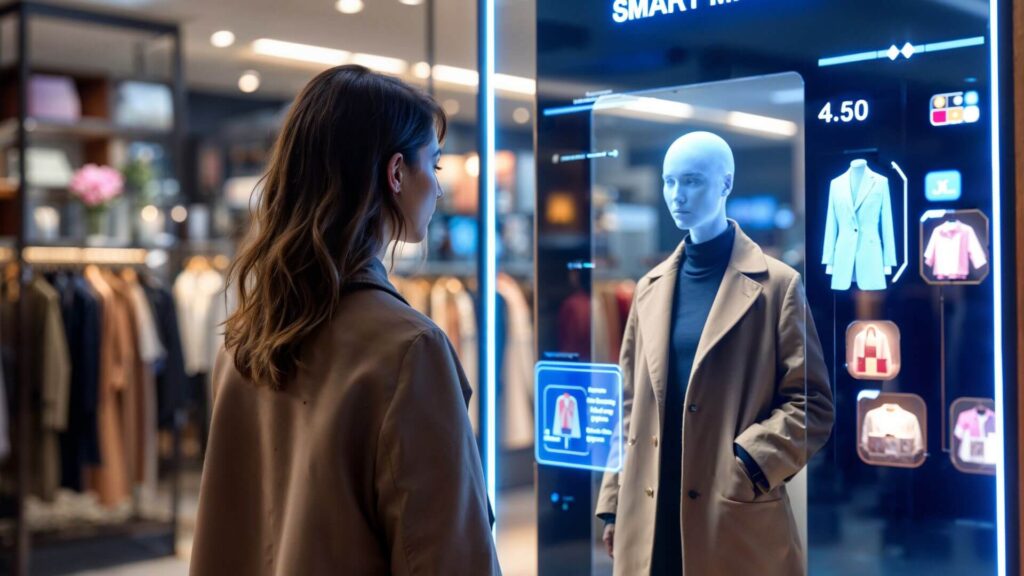
In this context, the Advertising mirror introduces a particularly interesting concept: transforming an everyday surface such as a mirror into a digital channel capable of combining functionality, visual communication, and interaction.
This technology makes it possible to integrate advertising content into spaces where digital experiences traditionally did not exist, creating new touchpoints between brands and consumers.
Mirrors are naturally part of different commercial environments, especially in fashion, beauty, accessories, and experiential retail. Their primary function is to allow consumers to see a product or their own reflection.
Adding digital technology introduces a new dimension to that moment.
Instead of functioning solely as a practical surface, a mirror can become a platform for displaying campaigns, promotions, product information, or branded content.
This makes it possible to take advantage of moments when consumers are already paying attention to the space, without introducing a completely separate element into the experience.
A conventional advertising screen is designed to capture attention through visual content. A digital mirror follows a different approach: it integrates communication into a surface that already has a function for the user.
This combination can create more natural experiences within certain commercial environments.
An Advertising mirror can be used to display dynamic content, seasonal campaigns, promotional messages, product recommendations, or information related to the products surrounding the consumer.
Depending on the technology and configuration, it can also incorporate interactive features that allow users to participate directly in the experience.

One of the main advantages of this technology is that advertising can become part of the customer’s journey rather than appearing as a completely separate element.
Imagine a fashion store where a customer uses a mirror to see how a garment looks. While performing this action, the device can complement the experience with information about collections, related products, or current campaigns.
Communication is no longer simply a message that the consumer observes. Instead, it becomes part of a specific moment in their experience.
This characteristic creates new opportunities for brands looking to communicate without interrupting the customer’s journey through the store.
The use of digital mirrors can be adapted to different commercial and communication objectives.
Promotions and dynamic campaigns: they allow messages to be updated according to seasons, launches, events, or promotions without physically modifying the space.
Product information: they can complement the shopping experience by displaying features, recommendations, or additional content related to specific products.
Branding: the mirror can become an extension of the brand’s visual identity, using audiovisual content and graphic elements that align with its communication strategy.
Interactive experiences: when the technology supports it, users can select options, explore content, or interact directly with the information displayed.
Contextual content: communication can be adapted to the location of the device and the specific moment in the customer’s journey.
The key is ensuring that the technology serves a clear purpose within the experience rather than simply becoming an eye-catching element.
The potential of this technology is not limited to the inside of a store.
Advertising mirrors can be integrated into different touchpoints throughout a commercial environment.
In storefronts, they can attract the attention of people passing by. In fitting areas, they can complement experiences related to fashion or beauty products. In showrooms, they can provide additional information about products and collections.
They can also become part of temporary installations, brand events, or special experiences where the goal is to generate greater interaction with the audience.
This makes it possible to think of retail as a journey made up of different communication moments, rather than limiting advertising to signs, displays, or traditional screens.
Innovative technology needs the right content to fulfill its purpose.
A digital mirror may have a visually striking presence, but if the information it displays is not relevant or the interaction is complicated, much of its value can be lost.
Content should consider the environment in which the device is located, the user’s attention span, and the action the experience is intended to generate.
It is also important to maintain clear visual communication. Promotional messages should be easy to understand, while navigation, when available, should be intuitive.
In this sense, content design for an Advertising mirror requires more than simply adapting a traditional advertising piece. The communication needs to coexist naturally with the mirror’s primary function.
Before incorporating this technology into a retail project, several factors should be analyzed.
Location: where the mirror is installed determines how much time users have to interact with it and what type of content may be most appropriate.
Visibility: lighting, viewing distance, and the layout of the space can affect how digital content is perceived.
Interaction: if the project includes interactive features, the experience should be simple and accessible.
Connectivity: the system needs suitable infrastructure to manage digital content and interactive functions.
Content management: a professional solution should make it easy to update campaigns and messages according to the brand’s needs.
Maintenance: like any technology integrated into a commercial environment, technical support and maintenance should be considered to maintain a consistent experience.
Evaluating these elements before implementation helps ensure that the project responds to a strategy rather than simply following a technology trend.
Retail is moving toward environments where products, architecture, and technology work together to create more complete experiences.
In this scenario, digital mirrors can introduce a new form of communication because they take advantage of an element that is already part of consumer behavior and transform it into an opportunity for brand interaction.
The goal is not to replace traditional screens, but to expand communication possibilities and identify new moments when technology can add value.
An Advertising mirror can transform a functional surface into a dynamic touchpoint, combining advertising, content, and interaction within a single experience.
At ENO Digital Signage, we develop solutions designed to integrate technology and communication into commercial environments, helping brands create digital experiences that connect with their audiences in new ways.
If you want to learn more about the technologies transforming Digital Signage, follow us on Instagram and LinkedIn and explore our previous blog articles to discover new trends, solutions, and applications.